Federal TDG 2.43 certified WCB Alberta · Code 50714 UN3291-certified containers Documented chain of custody ABCA-incorporated · Edmonton Federal TDG 2.43 certified WCB Alberta · Code 50714 UN3291-certified containers Documented chain of custody ABCA-incorporated · Edmonton
Home/Biomedical & Hazardous/Oil Spill Response
Service S/09 · OIL SPILL RESPONSE

Contain it, recover it,
document it.
A hydrocarbon release on your site is a clock-running event — for the environment, for your permit, and for your liability. Bioshield provides on-call spill response in cities across Canada: rapid containment, absorbent deployment, recovery of free product, and licensed disposal of recovered hydrocarbon and contaminated soil or absorbent — all under a documented chain of custody you can hand to a regulator.

Response rate
Quoted
per incident · on-call · scoped on arrival
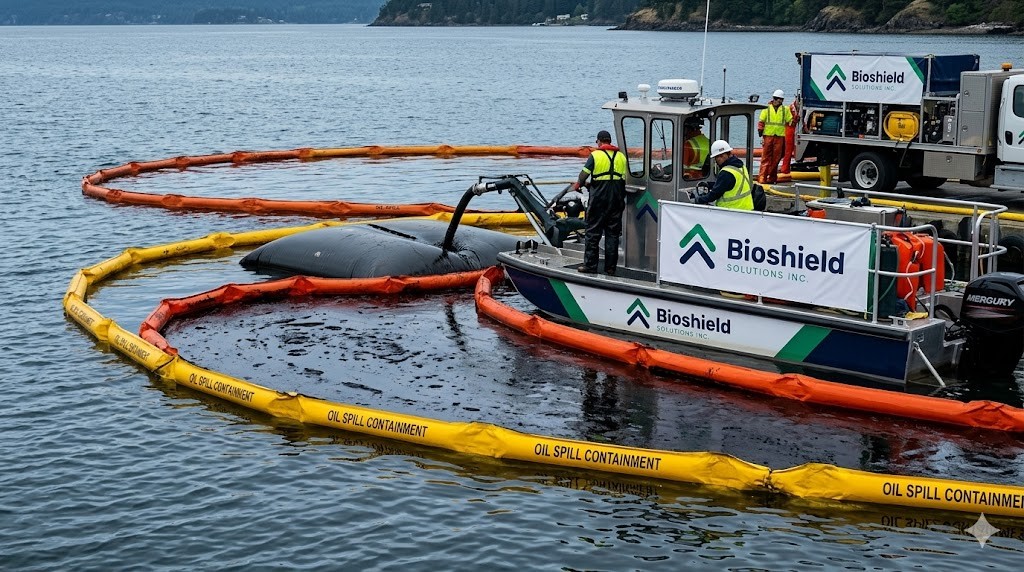
Bioshield oil-spill response crew with containment boom and a branded response vessel on the water

What this service covers

  • Containment — booms, berms, and barriers to stop migration to drains, soil, or watercourses
  • Absorbent deployment — pads, socks, and granular sorbents matched to the product
  • Free-product recovery — pumping and skimming of recoverable hydrocarbon
  • Contaminated media removal — saturated absorbent, soil, and debris haul-off
  • Licensed disposal — recovered product and contaminated media to permitted facilities
  • Incident documentation — manifests and records sized for regulator and insurer review

How it works

You call the dispatcher line and describe the release — product, approximate volume, surface, and whether it's reaching a drain, soil, or water. We confirm a response and dispatch a Class 3, TDG-certified driver with containment and recovery equipment. The first priority on arrival is always to stop migration; recovery and removal follow once the release is contained.

Recovered hydrocarbon and contaminated media are classified, manifested, and routed to licensed disposal. You receive the full incident record — containment actions, volumes recovered, manifests, and the disposal certificate — packaged so it can go straight into an insurer claim or a regulatory file. Records are archived for the seven-year Alberta retention window.

Target sectors

Fleet & transport yardsFuel & hydraulic releases
Auto & truck shopsOil, coolant, fuel spills
Industrial & warehousingEquipment & storage releases
Property & facilitiesGenerator & tank leaks
Construction sitesEquipment & fuelling spills
Fuel & service stationsDispenser & transfer spills

Pricing details

Spill response is quoted per incident — the scope isn't knowable until the product, volume, and affected media are confirmed on arrival. We scope and confirm costs on site before major recovery work begins; there's no fuel surcharge and no documentation fee layered on top. Existing accounts get priority dispatch.

This is an on-call service, not a scheduled route. The dispatcher line is the fastest path — call first, describe the release, and we move.
Regulatory framework

The credentials behind
this specific service.

Spill response touches regulated material, contaminated media, and reportable-release obligations — it runs under the full Bioshield credential set.

✓

Regulated-waste manifesting

Recovered hydrocarbon and contaminated media documented as regulated waste.

✓

Federal TDG 2.43

Driver certified to transport recovered product and contaminated soil.

✓

Containment & recovery SOP

Migration control prioritized before recovery on every response.

✓

Incident documentation

Records and manifests packaged for insurer and regulator review.

✓

WCB Alberta 50714

Active and in good standing for all field work.

Frequently asked

Oil spill response questions.

If it's safe, stop the source — close the valve, upright the container, shut off the pump. Then keep the product away from drains, catch basins, and soil using whatever you have on hand. Don't hose it down; that spreads it. Call the dispatcher line and we'll talk you through holding the line until the truck arrives.
Reportable-release obligations sit with the party responsible for the release, and thresholds depend on volume, product, and where it went. We document the incident to the standard a regulator expects, but we can't file your report for you — we can tell you what the record contains so you can meet your own obligation.
A 20-litre hydraulic spill on a shop floor and a 200-litre release reaching soil are completely different jobs in equipment, labour, and disposal volume. We scope on arrival and confirm costs before major recovery work begins, so you're never billed against an estimate that didn't match the site.
Yes. Saturated absorbent, contaminated soil, and debris are removed, classified, manifested, and hauled to licensed disposal alongside the recovered product — so the whole event closes under one documented chain of custody.
That's the ideal. Existing accounts get priority dispatch, and having the relationship in place means we already know your site, your products, and your access — which is exactly what you don't want to be explaining for the first time mid-incident.
Before you need it

Set up spill response now.

The best time to put a responder on your vendor list is before the clock is running. Existing accounts get priority dispatch.